Author: Julia Vetsikas

Continuous glucose monitoring (CGM) represents a key intervention for advancing the management of diabetes and enhancing the patient experience. Importantly, pharmacy professionals remain instrumental in CGM access and related patient education efforts. Although diabetes technology has seen increased uptake over the past several years, recent innovation in real-time CGM (rtCGM) highlights an opportunity for increased patient engagement and quality improvement in managed care. During this AMCP Northwest Affiliate CE dinner meeting held on April 13, 2023, experts Nicole Ehrhardt, MD and Carly Rodriguez, PharmD, FAMCP, reviewed evidenced-based recommendations supporting the use of rtCGM in a broader population of insulin-treated patients. A panel discussion featuring regional managed care leaders explored the value of rtCGM in optimizing outcomes and reducing resource utilization among members with diabetes.
The Centers for Medicare and Medicaid Services (CMS) expanded CGM access to beneficiaries on basal-only insulin or those with a history of level two or three hypoglycemia. Although the Local Coverage Determination (LCD) was originally anticipated to be implemented in July, CMS expanded access to CGM on April 16, 2023. This new coverage policy is aligned with consensus guidelines from the ADA and AACE, which recommend CGM for all patients on insulin at the outset of diagnosis. The new LCD, which was proposed in 2022, also removes the term “daily” as a descriptor for insulin to account for potential FDA approval of weekly insulins in the future.
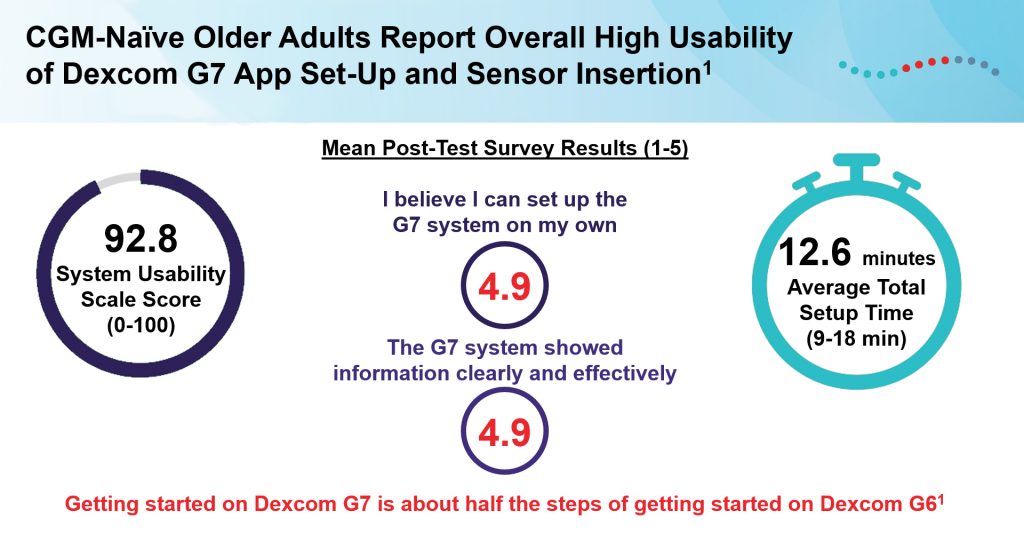
Learn MoreA task analysis and ease of use survey conducted among adults aged ≥65 years and certified diabetes care and education specialists (CDCESs) showed excellent useability associated with the new G7 RT-CGM system. Ease of use related to intradermal insertion and mobile app setup were assessed and compared to the fifth- and sixth-generation systems in the study, which recruited 10 older adults with no previous CGM experience and 10 CDCESs. The analysis revealed that approximately half as many tasks are needed to deploy the G7 system compared with the G6, resulting in excellent usability as assessed by older adults and CDCESs in the study, highlighted by a system usability score of 92.8. Cumulatively, these findings indicate a relatively low cognitive burden associated with the system compared with previous versions, simplifying the utilization of RT-CGM for older adults who are at higher risk for diabetes-related complications and stand to benefit from the implementation of diabetes technology. Managed care and payer decision makers may find the data presented in the study useful for informing coverage policy and criteria for RT-CGM in this vulnerable population of patients.
Psavko S, Katz N, Mirchi T, Green CR. Usability and Teachability of Continuous Glucose Monitoring Devices in Older Adults and Diabetes Educators: Task Analysis and Ease-of-Use Survey. JMIR Hum Factors. 2022;9(4):e42057.
International diabetes experts recently collaborated to provide recommendations on how to optimize CGM-derived glucose data collection in clinical studies, including the specific glucose metrics and specific glucose metrics that should be evaluated. These consensus recommendations have been endorsed by key professional organizations, including the American Association of Clinical Endocrinologists, the American Diabetes Association, the Association of Diabetes Care and Education Specialists, Diabetes India, the European Association for the Study of Diabetes, the International Society for Pediatric and Adolescent Diabetes, the Japanese Diabetes Society, and the Juvenile Diabetes Research Foundation. This recommended standardized approach to CGM data collection and reporting in clinical trials will encourage the use of uniform metrics and enhance the interpretability of CGM data. Managed care and payer professionals should note that these metrics offer a body of useful information beyond HbA1c to inform therapeutic and treatment decisions, particularly related to hypoglycemia, postprandial hyperglycemia, and glucose variability.
Battelino T, Alexander CM, Amiel SA, et al. Continuous glucose monitoring and metrics for clinical trials: an international consensus statement. Lancet Diabetes Endocrinol. 2023;11:42-57.
Learn More