Evidence
October 11, 2021Clinical Outcomes Article / Publication
Source: Endocrine Today
“Our real-world study found that in patients with insulin-treated diabetes, initiating a continuous glucose monitor substantially improved blood glucose control and cut the rate of emergency room visits for hypoglycemia in half,”
Andre J . Karter, PhD
Learn MoreSeptember 29, 2021CGM Technology and Digital Health Article / Publication

Source: Diabetes Technology & Therapeutics
Published: September 2021
Learn MoreLower A1c and Reduce Hospital/ED Use in Members with Insulin-Treated Type 2 Diabetes via Real-Time Continuous Glucose Monitoring
September 16, 2021Clinical Outcomes Economic Outcomes Infographic

Optimize Outcomes in Insulin-Treated T1 and T2D via Evidence-Based Coverage Criteria with Real-Time Continuous Glucose Monitoring
September 16, 2021Clinical Outcomes Coverage and Benefit Design Economic Outcomes Infographic

Association Between Real-Time Continuous Glucose Monitor Use and Diabetes-Related Medical Costs for Patients with Type 2 Diabetes
September 2, 2021Clinical Outcomes Economic Outcomes Article / PublicationLearn MoreReal-World Studies Support Use of Continuous Glucose Monitoring in Type 1 and Type 2 Diabetes Independently of Treatment Regimen
September 2, 2021Clinical Outcomes Article / PublicationLearn MoreReal-Time Continuous Glucose Monitor (RTCGM) Use Associated with Decreased Diabetes Medical Costs for Patients with Type 2 Diabetes (T2D)
August 9, 2021Economic Outcomes Article / Publication
Source: Digital Technology and Therapeutics
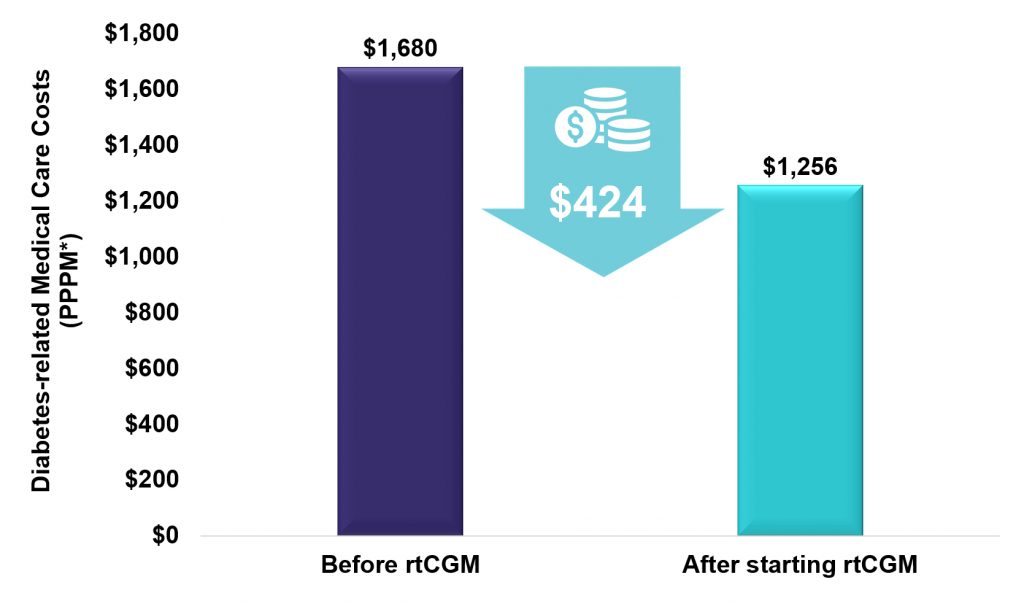
Key Takeaway: A retrospective analysis of administrative claims data from the Optum Research Database showed rtCGM use was associated with diabetes-related medical cost reductions in patients with T2D. Increased access to rtCGM for patients with T2D may help to reduce diabetes-related cost of care.
Diabetes-related Medical Care Costs Decreased $424 PPPM After Initiating rtCGM Treatment

*PPPM = per patient per month
Learn MoreJune 23, 2021Clinical Outcomes Article / Publication
Source: The Journal of the American Medical Association
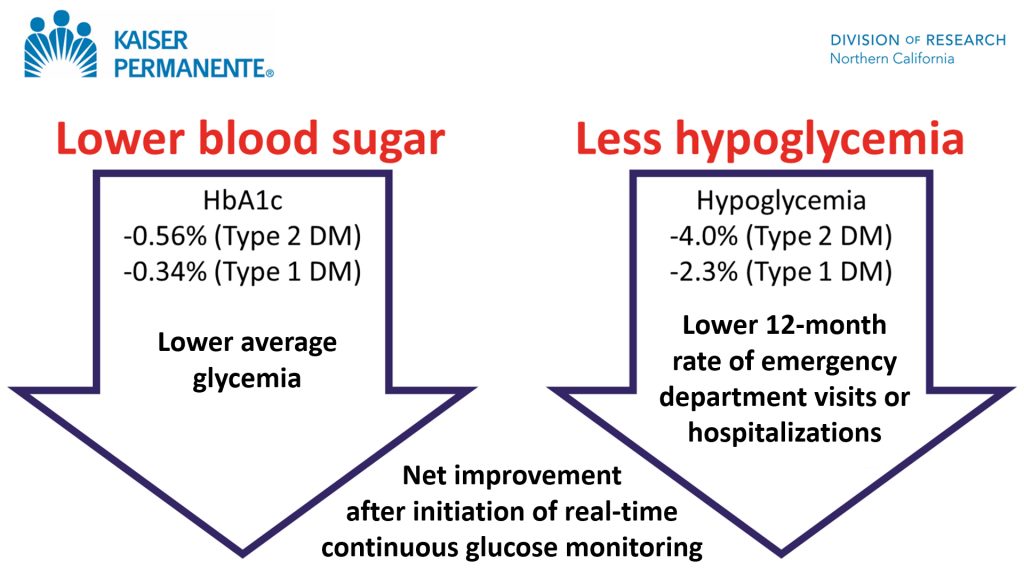
Key Takeaways: Continuous Glucose Monitoring improved outcomes more than intermittent testing of blood glucose in 41,753 patients with insulin-treated diabetes.
“Our real-world study found that in patients with insulin-treated diabetes, initiating a continuous glucose monitor substantially improved blood glucose control and cut the rate of emergency room visits for hypoglycemia in half.”1
Andrew J. Karter, PhD, Senior Research Scientist at Kaiser Permanente Division of Research

1Shaffer R. Real-time CGM lowers HbA1c, reduces ED visits in insulin-treated diabetes. Endocrine Today. June 2021. https://www.healio.com/news/endocrinology/20210607/realtime-cgm-lowers-hba1c-reduces-ed-visits-in-insulintreated-diabetes. Accessed June 24, 2021.
Learn MoreJune 22, 2021Clinical Outcomes Coverage and Benefit Design Article / Publication
Source: The Journal of the American Medical Association
Authors: Monica E. Peek, MD, MPH, MS; Celeste C. Thomas, MD, MS
“…the studies by Karter et al. and Martens et al. provide additional evidence that patients with type 2 diabetes benefit from the use of CGM in terms of improved HbA1c level, time spent in the target blood glucose range, and reduced hypoglycemic episodes…”
“…institutional changes that promote its use in primary care will go a long way to improving diabetes control and reducing complications, particularly among the populations most in need. The time has come to broaden access to CGM for patients with type 2 diabetes.”
Learn MoreEffect of Continuous Glucose Monitoring on Glycemic Control in Patients with Type 2 Diabetes Treated with Basal Insulin: A Randomized Clinical Trial
June 21, 2021Clinical Outcomes Article / Publication
Source: The Journal of the American Medical Association
Learn More
Sign Up To Stay Current On The Latest Coverage
Updates, Recent News, And Resources
Source: Endocrine Today
“Our real-world study found that in patients with insulin-treated diabetes, initiating a continuous glucose monitor substantially improved blood glucose control and cut the rate of emergency room visits for hypoglycemia in half,”
Andre J . Karter, PhD
Learn More
September 29, 2021CGM Technology and Digital Health Article / Publication
Source: Diabetes Technology & Therapeutics
Published: September 2021
Learn MoreLower A1c and Reduce Hospital/ED Use in Members with Insulin-Treated Type 2 Diabetes via Real-Time Continuous Glucose Monitoring
September 16, 2021Clinical Outcomes Economic Outcomes Infographic
Learn MoreOptimize Outcomes in Insulin-Treated T1 and T2D via Evidence-Based Coverage Criteria with Real-Time Continuous Glucose Monitoring
September 16, 2021Clinical Outcomes Coverage and Benefit Design Economic Outcomes Infographic
Learn MoreAssociation Between Real-Time Continuous Glucose Monitor Use and Diabetes-Related Medical Costs for Patients with Type 2 Diabetes
September 2, 2021Clinical Outcomes Economic Outcomes Article / PublicationLearn MoreReal-World Studies Support Use of Continuous Glucose Monitoring in Type 1 and Type 2 Diabetes Independently of Treatment Regimen
September 2, 2021Clinical Outcomes Article / PublicationLearn MoreReal-Time Continuous Glucose Monitor (RTCGM) Use Associated with Decreased Diabetes Medical Costs for Patients with Type 2 Diabetes (T2D)
August 9, 2021Economic Outcomes Article / Publication
Source: Digital Technology and Therapeutics
Key Takeaway: A retrospective analysis of administrative claims data from the Optum Research Database showed rtCGM use was associated with diabetes-related medical cost reductions in patients with T2D. Increased access to rtCGM for patients with T2D may help to reduce diabetes-related cost of care.
Diabetes-related Medical Care Costs Decreased $424 PPPM After Initiating rtCGM Treatment
*PPPM = per patient per month
Learn MoreJune 23, 2021Clinical Outcomes Article / Publication
Source: The Journal of the American Medical Association
Key Takeaways: Continuous Glucose Monitoring improved outcomes more than intermittent testing of blood glucose in 41,753 patients with insulin-treated diabetes.
“Our real-world study found that in patients with insulin-treated diabetes, initiating a continuous glucose monitor substantially improved blood glucose control and cut the rate of emergency room visits for hypoglycemia in half.”1
Andrew J. Karter, PhD, Senior Research Scientist at Kaiser Permanente Division of Research
1Shaffer R. Real-time CGM lowers HbA1c, reduces ED visits in insulin-treated diabetes. Endocrine Today. June 2021. https://www.healio.com/news/endocrinology/20210607/realtime-cgm-lowers-hba1c-reduces-ed-visits-in-insulintreated-diabetes. Accessed June 24, 2021.
Learn MoreJune 22, 2021Clinical Outcomes Coverage and Benefit Design Article / Publication
Source: The Journal of the American Medical Association
Authors: Monica E. Peek, MD, MPH, MS; Celeste C. Thomas, MD, MS
“…the studies by Karter et al. and Martens et al. provide additional evidence that patients with type 2 diabetes benefit from the use of CGM in terms of improved HbA1c level, time spent in the target blood glucose range, and reduced hypoglycemic episodes…”
“…institutional changes that promote its use in primary care will go a long way to improving diabetes control and reducing complications, particularly among the populations most in need. The time has come to broaden access to CGM for patients with type 2 diabetes.”
Learn MoreEffect of Continuous Glucose Monitoring on Glycemic Control in Patients with Type 2 Diabetes Treated with Basal Insulin: A Randomized Clinical Trial
June 21, 2021Clinical Outcomes Article / Publication
Source: The Journal of the American Medical Association
Learn More
Sign Up To Stay Current On The Latest Coverage
Updates, Recent News, And Resources

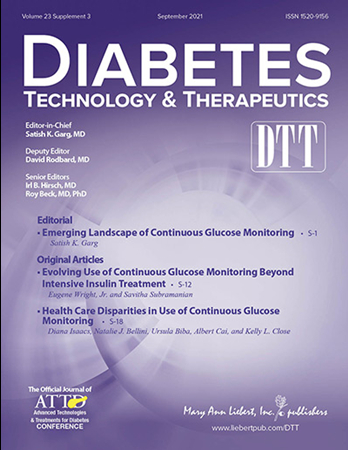
Source: Diabetes Technology & Therapeutics
Published: September 2021
Learn MoreLower A1c and Reduce Hospital/ED Use in Members with Insulin-Treated Type 2 Diabetes via Real-Time Continuous Glucose Monitoring
September 16, 2021Clinical Outcomes Economic Outcomes Infographic
Learn MoreOptimize Outcomes in Insulin-Treated T1 and T2D via Evidence-Based Coverage Criteria with Real-Time Continuous Glucose Monitoring
September 16, 2021Clinical Outcomes Coverage and Benefit Design Economic Outcomes Infographic
Learn MoreAssociation Between Real-Time Continuous Glucose Monitor Use and Diabetes-Related Medical Costs for Patients with Type 2 Diabetes
September 2, 2021Clinical Outcomes Economic Outcomes Article / PublicationLearn MoreReal-World Studies Support Use of Continuous Glucose Monitoring in Type 1 and Type 2 Diabetes Independently of Treatment Regimen
September 2, 2021Clinical Outcomes Article / PublicationLearn MoreReal-Time Continuous Glucose Monitor (RTCGM) Use Associated with Decreased Diabetes Medical Costs for Patients with Type 2 Diabetes (T2D)
August 9, 2021Economic Outcomes Article / Publication
Source: Digital Technology and Therapeutics
Key Takeaway: A retrospective analysis of administrative claims data from the Optum Research Database showed rtCGM use was associated with diabetes-related medical cost reductions in patients with T2D. Increased access to rtCGM for patients with T2D may help to reduce diabetes-related cost of care.
Diabetes-related Medical Care Costs Decreased $424 PPPM After Initiating rtCGM Treatment
*PPPM = per patient per month
Learn MoreJune 23, 2021Clinical Outcomes Article / Publication
Source: The Journal of the American Medical Association
Key Takeaways: Continuous Glucose Monitoring improved outcomes more than intermittent testing of blood glucose in 41,753 patients with insulin-treated diabetes.
“Our real-world study found that in patients with insulin-treated diabetes, initiating a continuous glucose monitor substantially improved blood glucose control and cut the rate of emergency room visits for hypoglycemia in half.”1
Andrew J. Karter, PhD, Senior Research Scientist at Kaiser Permanente Division of Research
1Shaffer R. Real-time CGM lowers HbA1c, reduces ED visits in insulin-treated diabetes. Endocrine Today. June 2021. https://www.healio.com/news/endocrinology/20210607/realtime-cgm-lowers-hba1c-reduces-ed-visits-in-insulintreated-diabetes. Accessed June 24, 2021.
Learn MoreJune 22, 2021Clinical Outcomes Coverage and Benefit Design Article / Publication
Source: The Journal of the American Medical Association
Authors: Monica E. Peek, MD, MPH, MS; Celeste C. Thomas, MD, MS
“…the studies by Karter et al. and Martens et al. provide additional evidence that patients with type 2 diabetes benefit from the use of CGM in terms of improved HbA1c level, time spent in the target blood glucose range, and reduced hypoglycemic episodes…”
“…institutional changes that promote its use in primary care will go a long way to improving diabetes control and reducing complications, particularly among the populations most in need. The time has come to broaden access to CGM for patients with type 2 diabetes.”
Learn MoreEffect of Continuous Glucose Monitoring on Glycemic Control in Patients with Type 2 Diabetes Treated with Basal Insulin: A Randomized Clinical Trial
June 21, 2021Clinical Outcomes Article / Publication
Source: The Journal of the American Medical Association
Learn More
Sign Up To Stay Current On The Latest Coverage
Updates, Recent News, And Resources


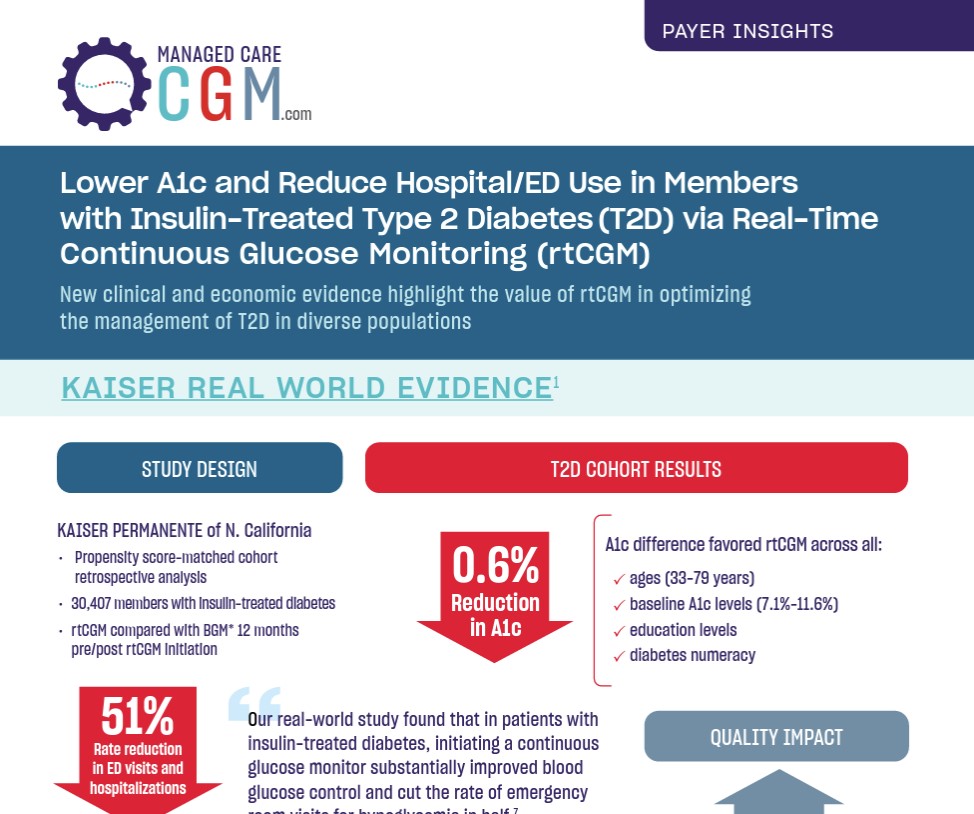
Lower A1c and Reduce Hospital/ED Use in Members with Insulin-Treated Type 2 Diabetes via Real-Time Continuous Glucose Monitoring
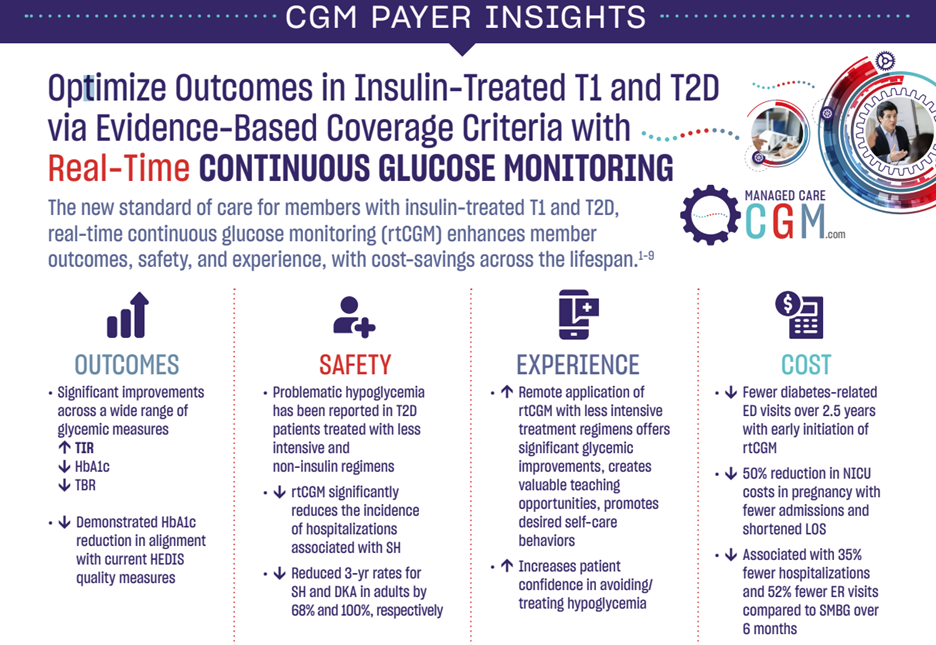
Optimize Outcomes in Insulin-Treated T1 and T2D via Evidence-Based Coverage Criteria with Real-Time Continuous Glucose Monitoring
September 16, 2021Clinical Outcomes Coverage and Benefit Design Economic Outcomes Infographic
Learn MoreAssociation Between Real-Time Continuous Glucose Monitor Use and Diabetes-Related Medical Costs for Patients with Type 2 Diabetes
September 2, 2021Clinical Outcomes Economic Outcomes Article / PublicationLearn MoreReal-World Studies Support Use of Continuous Glucose Monitoring in Type 1 and Type 2 Diabetes Independently of Treatment Regimen
September 2, 2021Clinical Outcomes Article / PublicationLearn MoreReal-Time Continuous Glucose Monitor (RTCGM) Use Associated with Decreased Diabetes Medical Costs for Patients with Type 2 Diabetes (T2D)
August 9, 2021Economic Outcomes Article / Publication
Source: Digital Technology and Therapeutics
Key Takeaway: A retrospective analysis of administrative claims data from the Optum Research Database showed rtCGM use was associated with diabetes-related medical cost reductions in patients with T2D. Increased access to rtCGM for patients with T2D may help to reduce diabetes-related cost of care.
Diabetes-related Medical Care Costs Decreased $424 PPPM After Initiating rtCGM Treatment
*PPPM = per patient per month
Learn MoreJune 23, 2021Clinical Outcomes Article / Publication
Source: The Journal of the American Medical Association
Key Takeaways: Continuous Glucose Monitoring improved outcomes more than intermittent testing of blood glucose in 41,753 patients with insulin-treated diabetes.
“Our real-world study found that in patients with insulin-treated diabetes, initiating a continuous glucose monitor substantially improved blood glucose control and cut the rate of emergency room visits for hypoglycemia in half.”1
Andrew J. Karter, PhD, Senior Research Scientist at Kaiser Permanente Division of Research
1Shaffer R. Real-time CGM lowers HbA1c, reduces ED visits in insulin-treated diabetes. Endocrine Today. June 2021. https://www.healio.com/news/endocrinology/20210607/realtime-cgm-lowers-hba1c-reduces-ed-visits-in-insulintreated-diabetes. Accessed June 24, 2021.
Learn MoreJune 22, 2021Clinical Outcomes Coverage and Benefit Design Article / Publication
Source: The Journal of the American Medical Association
Authors: Monica E. Peek, MD, MPH, MS; Celeste C. Thomas, MD, MS
“…the studies by Karter et al. and Martens et al. provide additional evidence that patients with type 2 diabetes benefit from the use of CGM in terms of improved HbA1c level, time spent in the target blood glucose range, and reduced hypoglycemic episodes…”
“…institutional changes that promote its use in primary care will go a long way to improving diabetes control and reducing complications, particularly among the populations most in need. The time has come to broaden access to CGM for patients with type 2 diabetes.”
Learn MoreEffect of Continuous Glucose Monitoring on Glycemic Control in Patients with Type 2 Diabetes Treated with Basal Insulin: A Randomized Clinical Trial
June 21, 2021Clinical Outcomes Article / Publication
Source: The Journal of the American Medical Association
Learn More
Sign Up To Stay Current On The Latest Coverage
Updates, Recent News, And Resources
Optimize Outcomes in Insulin-Treated T1 and T2D via Evidence-Based Coverage Criteria with Real-Time Continuous Glucose Monitoring
Association Between Real-Time Continuous Glucose Monitor Use and Diabetes-Related Medical Costs for Patients with Type 2 Diabetes
September 2, 2021Clinical Outcomes Economic Outcomes Article / PublicationLearn MoreReal-World Studies Support Use of Continuous Glucose Monitoring in Type 1 and Type 2 Diabetes Independently of Treatment Regimen
September 2, 2021Clinical Outcomes Article / PublicationLearn MoreReal-Time Continuous Glucose Monitor (RTCGM) Use Associated with Decreased Diabetes Medical Costs for Patients with Type 2 Diabetes (T2D)
August 9, 2021Economic Outcomes Article / Publication
Source: Digital Technology and Therapeutics
Key Takeaway: A retrospective analysis of administrative claims data from the Optum Research Database showed rtCGM use was associated with diabetes-related medical cost reductions in patients with T2D. Increased access to rtCGM for patients with T2D may help to reduce diabetes-related cost of care.
Diabetes-related Medical Care Costs Decreased $424 PPPM After Initiating rtCGM Treatment
*PPPM = per patient per month
Learn MoreJune 23, 2021Clinical Outcomes Article / Publication
Source: The Journal of the American Medical Association
Key Takeaways: Continuous Glucose Monitoring improved outcomes more than intermittent testing of blood glucose in 41,753 patients with insulin-treated diabetes.
“Our real-world study found that in patients with insulin-treated diabetes, initiating a continuous glucose monitor substantially improved blood glucose control and cut the rate of emergency room visits for hypoglycemia in half.”1
Andrew J. Karter, PhD, Senior Research Scientist at Kaiser Permanente Division of Research
1Shaffer R. Real-time CGM lowers HbA1c, reduces ED visits in insulin-treated diabetes. Endocrine Today. June 2021. https://www.healio.com/news/endocrinology/20210607/realtime-cgm-lowers-hba1c-reduces-ed-visits-in-insulintreated-diabetes. Accessed June 24, 2021.
Learn MoreJune 22, 2021Clinical Outcomes Coverage and Benefit Design Article / Publication
Source: The Journal of the American Medical Association
Authors: Monica E. Peek, MD, MPH, MS; Celeste C. Thomas, MD, MS
“…the studies by Karter et al. and Martens et al. provide additional evidence that patients with type 2 diabetes benefit from the use of CGM in terms of improved HbA1c level, time spent in the target blood glucose range, and reduced hypoglycemic episodes…”
“…institutional changes that promote its use in primary care will go a long way to improving diabetes control and reducing complications, particularly among the populations most in need. The time has come to broaden access to CGM for patients with type 2 diabetes.”
Learn MoreEffect of Continuous Glucose Monitoring on Glycemic Control in Patients with Type 2 Diabetes Treated with Basal Insulin: A Randomized Clinical Trial
June 21, 2021Clinical Outcomes Article / Publication
Source: The Journal of the American Medical Association
Learn More
Sign Up To Stay Current On The Latest Coverage
Updates, Recent News, And Resources
Association Between Real-Time Continuous Glucose Monitor Use and Diabetes-Related Medical Costs for Patients with Type 2 Diabetes
Real-World Studies Support Use of Continuous Glucose Monitoring in Type 1 and Type 2 Diabetes Independently of Treatment Regimen
September 2, 2021Clinical Outcomes Article / PublicationLearn MoreReal-Time Continuous Glucose Monitor (RTCGM) Use Associated with Decreased Diabetes Medical Costs for Patients with Type 2 Diabetes (T2D)
August 9, 2021Economic Outcomes Article / Publication
Source: Digital Technology and Therapeutics
Key Takeaway: A retrospective analysis of administrative claims data from the Optum Research Database showed rtCGM use was associated with diabetes-related medical cost reductions in patients with T2D. Increased access to rtCGM for patients with T2D may help to reduce diabetes-related cost of care.
Diabetes-related Medical Care Costs Decreased $424 PPPM After Initiating rtCGM Treatment
*PPPM = per patient per month
Learn MoreJune 23, 2021Clinical Outcomes Article / Publication
Source: The Journal of the American Medical Association
Key Takeaways: Continuous Glucose Monitoring improved outcomes more than intermittent testing of blood glucose in 41,753 patients with insulin-treated diabetes.
“Our real-world study found that in patients with insulin-treated diabetes, initiating a continuous glucose monitor substantially improved blood glucose control and cut the rate of emergency room visits for hypoglycemia in half.”1
Andrew J. Karter, PhD, Senior Research Scientist at Kaiser Permanente Division of Research
1Shaffer R. Real-time CGM lowers HbA1c, reduces ED visits in insulin-treated diabetes. Endocrine Today. June 2021. https://www.healio.com/news/endocrinology/20210607/realtime-cgm-lowers-hba1c-reduces-ed-visits-in-insulintreated-diabetes. Accessed June 24, 2021.
Learn MoreJune 22, 2021Clinical Outcomes Coverage and Benefit Design Article / Publication
Source: The Journal of the American Medical Association
Authors: Monica E. Peek, MD, MPH, MS; Celeste C. Thomas, MD, MS
“…the studies by Karter et al. and Martens et al. provide additional evidence that patients with type 2 diabetes benefit from the use of CGM in terms of improved HbA1c level, time spent in the target blood glucose range, and reduced hypoglycemic episodes…”
“…institutional changes that promote its use in primary care will go a long way to improving diabetes control and reducing complications, particularly among the populations most in need. The time has come to broaden access to CGM for patients with type 2 diabetes.”
Learn MoreEffect of Continuous Glucose Monitoring on Glycemic Control in Patients with Type 2 Diabetes Treated with Basal Insulin: A Randomized Clinical Trial
June 21, 2021Clinical Outcomes Article / Publication
Source: The Journal of the American Medical Association
Learn More
Sign Up To Stay Current On The Latest Coverage
Updates, Recent News, And Resources
Real-World Studies Support Use of Continuous Glucose Monitoring in Type 1 and Type 2 Diabetes Independently of Treatment Regimen
Real-Time Continuous Glucose Monitor (RTCGM) Use Associated with Decreased Diabetes Medical Costs for Patients with Type 2 Diabetes (T2D)
August 9, 2021Economic Outcomes Article / Publication
Source: Digital Technology and Therapeutics
Key Takeaway: A retrospective analysis of administrative claims data from the Optum Research Database showed rtCGM use was associated with diabetes-related medical cost reductions in patients with T2D. Increased access to rtCGM for patients with T2D may help to reduce diabetes-related cost of care.
Diabetes-related Medical Care Costs Decreased $424 PPPM After Initiating rtCGM Treatment
*PPPM = per patient per month
Learn MoreJune 23, 2021Clinical Outcomes Article / Publication
Source: The Journal of the American Medical Association
Key Takeaways: Continuous Glucose Monitoring improved outcomes more than intermittent testing of blood glucose in 41,753 patients with insulin-treated diabetes.
“Our real-world study found that in patients with insulin-treated diabetes, initiating a continuous glucose monitor substantially improved blood glucose control and cut the rate of emergency room visits for hypoglycemia in half.”1
Andrew J. Karter, PhD, Senior Research Scientist at Kaiser Permanente Division of Research
1Shaffer R. Real-time CGM lowers HbA1c, reduces ED visits in insulin-treated diabetes. Endocrine Today. June 2021. https://www.healio.com/news/endocrinology/20210607/realtime-cgm-lowers-hba1c-reduces-ed-visits-in-insulintreated-diabetes. Accessed June 24, 2021.
Learn MoreJune 22, 2021Clinical Outcomes Coverage and Benefit Design Article / Publication
Source: The Journal of the American Medical Association
Authors: Monica E. Peek, MD, MPH, MS; Celeste C. Thomas, MD, MS
“…the studies by Karter et al. and Martens et al. provide additional evidence that patients with type 2 diabetes benefit from the use of CGM in terms of improved HbA1c level, time spent in the target blood glucose range, and reduced hypoglycemic episodes…”
“…institutional changes that promote its use in primary care will go a long way to improving diabetes control and reducing complications, particularly among the populations most in need. The time has come to broaden access to CGM for patients with type 2 diabetes.”
Learn MoreEffect of Continuous Glucose Monitoring on Glycemic Control in Patients with Type 2 Diabetes Treated with Basal Insulin: A Randomized Clinical Trial
June 21, 2021Clinical Outcomes Article / Publication
Source: The Journal of the American Medical Association
Learn More
Sign Up To Stay Current On The Latest Coverage
Updates, Recent News, And Resources
Real-Time Continuous Glucose Monitor (RTCGM) Use Associated with Decreased Diabetes Medical Costs for Patients with Type 2 Diabetes (T2D)
Source: Digital Technology and Therapeutics
Key Takeaway: A retrospective analysis of administrative claims data from the Optum Research Database showed rtCGM use was associated with diabetes-related medical cost reductions in patients with T2D. Increased access to rtCGM for patients with T2D may help to reduce diabetes-related cost of care.
Diabetes-related Medical Care Costs Decreased $424 PPPM After Initiating rtCGM Treatment
*PPPM = per patient per month
Learn MoreJune 23, 2021Clinical Outcomes Article / Publication
Source: The Journal of the American Medical Association
Key Takeaways: Continuous Glucose Monitoring improved outcomes more than intermittent testing of blood glucose in 41,753 patients with insulin-treated diabetes.
“Our real-world study found that in patients with insulin-treated diabetes, initiating a continuous glucose monitor substantially improved blood glucose control and cut the rate of emergency room visits for hypoglycemia in half.”1
Andrew J. Karter, PhD, Senior Research Scientist at Kaiser Permanente Division of Research
1Shaffer R. Real-time CGM lowers HbA1c, reduces ED visits in insulin-treated diabetes. Endocrine Today. June 2021. https://www.healio.com/news/endocrinology/20210607/realtime-cgm-lowers-hba1c-reduces-ed-visits-in-insulintreated-diabetes. Accessed June 24, 2021.
Learn MoreJune 22, 2021Clinical Outcomes Coverage and Benefit Design Article / Publication
Source: The Journal of the American Medical Association
Authors: Monica E. Peek, MD, MPH, MS; Celeste C. Thomas, MD, MS
“…the studies by Karter et al. and Martens et al. provide additional evidence that patients with type 2 diabetes benefit from the use of CGM in terms of improved HbA1c level, time spent in the target blood glucose range, and reduced hypoglycemic episodes…”
“…institutional changes that promote its use in primary care will go a long way to improving diabetes control and reducing complications, particularly among the populations most in need. The time has come to broaden access to CGM for patients with type 2 diabetes.”
Learn MoreEffect of Continuous Glucose Monitoring on Glycemic Control in Patients with Type 2 Diabetes Treated with Basal Insulin: A Randomized Clinical Trial
June 21, 2021Clinical Outcomes Article / Publication
Source: The Journal of the American Medical Association
Learn More
Sign Up To Stay Current On The Latest Coverage
Updates, Recent News, And Resources

Source: The Journal of the American Medical Association
Key Takeaways: Continuous Glucose Monitoring improved outcomes more than intermittent testing of blood glucose in 41,753 patients with insulin-treated diabetes.
“Our real-world study found that in patients with insulin-treated diabetes, initiating a continuous glucose monitor substantially improved blood glucose control and cut the rate of emergency room visits for hypoglycemia in half.”1
Andrew J. Karter, PhD, Senior Research Scientist at Kaiser Permanente Division of Research
1Shaffer R. Real-time CGM lowers HbA1c, reduces ED visits in insulin-treated diabetes. Endocrine Today. June 2021. https://www.healio.com/news/endocrinology/20210607/realtime-cgm-lowers-hba1c-reduces-ed-visits-in-insulintreated-diabetes. Accessed June 24, 2021.
Learn MoreJune 22, 2021Clinical Outcomes Coverage and Benefit Design Article / Publication
Source: The Journal of the American Medical Association
Authors: Monica E. Peek, MD, MPH, MS; Celeste C. Thomas, MD, MS
“…the studies by Karter et al. and Martens et al. provide additional evidence that patients with type 2 diabetes benefit from the use of CGM in terms of improved HbA1c level, time spent in the target blood glucose range, and reduced hypoglycemic episodes…”
“…institutional changes that promote its use in primary care will go a long way to improving diabetes control and reducing complications, particularly among the populations most in need. The time has come to broaden access to CGM for patients with type 2 diabetes.”
Learn MoreEffect of Continuous Glucose Monitoring on Glycemic Control in Patients with Type 2 Diabetes Treated with Basal Insulin: A Randomized Clinical Trial
June 21, 2021Clinical Outcomes Article / Publication
Source: The Journal of the American Medical Association
Learn More
Sign Up To Stay Current On The Latest Coverage
Updates, Recent News, And Resources
Source: The Journal of the American Medical Association
Authors: Monica E. Peek, MD, MPH, MS; Celeste C. Thomas, MD, MS
“…the studies by Karter et al. and Martens et al. provide additional evidence that patients with type 2 diabetes benefit from the use of CGM in terms of improved HbA1c level, time spent in the target blood glucose range, and reduced hypoglycemic episodes…”
“…institutional changes that promote its use in primary care will go a long way to improving diabetes control and reducing complications, particularly among the populations most in need. The time has come to broaden access to CGM for patients with type 2 diabetes.”
Learn More
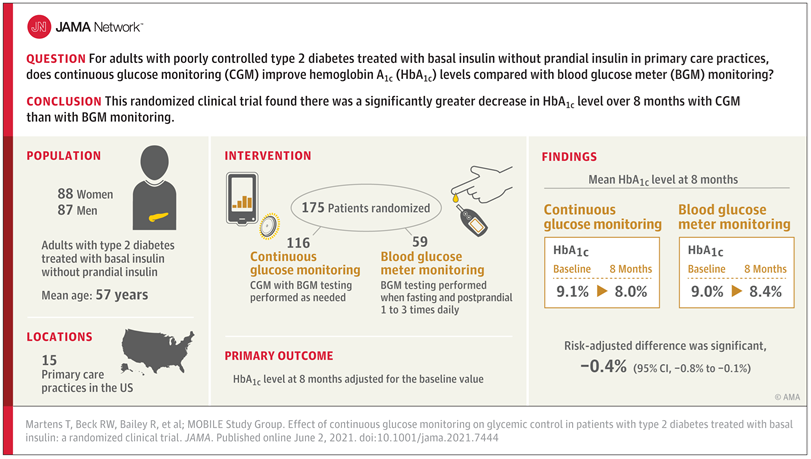
Effect of Continuous Glucose Monitoring on Glycemic Control in Patients with Type 2 Diabetes Treated with Basal Insulin: A Randomized Clinical Trial
June 21, 2021Clinical Outcomes Article / Publication
Source: The Journal of the American Medical Association
Learn More
Effect of Continuous Glucose Monitoring on Glycemic Control in Patients with Type 2 Diabetes Treated with Basal Insulin: A Randomized Clinical Trial
Source: The Journal of the American Medical Association